
Deposit-Refund Structure
Under PEI’s Environmental Protection Act Materials Stewardship and Recycling Regulations, the Beverage Container Program will transition from a half-back model to a full deposit-refund model. Setting the deposit amounts is the responsibility of the PRO in its Stewardship Plan.
Retailers must collect deposits on beverage containers at the point of purchase, and consumers will receive a full deposit refund when returning empty containers for recycling at designated return facilities.
“A retailer shall collect from a consumer, at the time of the sale of a beverage container, a deposit in the amount specified in the beverage container stewardship plan under subsection 111.05(2), which shall include any applicable taxes.” PEI Materials Stewardship and Recycling Regulations EC349/14, section 111.09 (1)
“The amount of the refund for an empty beverage container shall be equal to the amount of deposit collected from a consumer for the beverage container at the time of sale.” PEI Materials Stewardship and Recycling Regulations EC349/14, section 111.09 (2)
Effective April 1, 2026, the deposit amounts, established by Encorp in its Stewardship Plan, will be as follows.
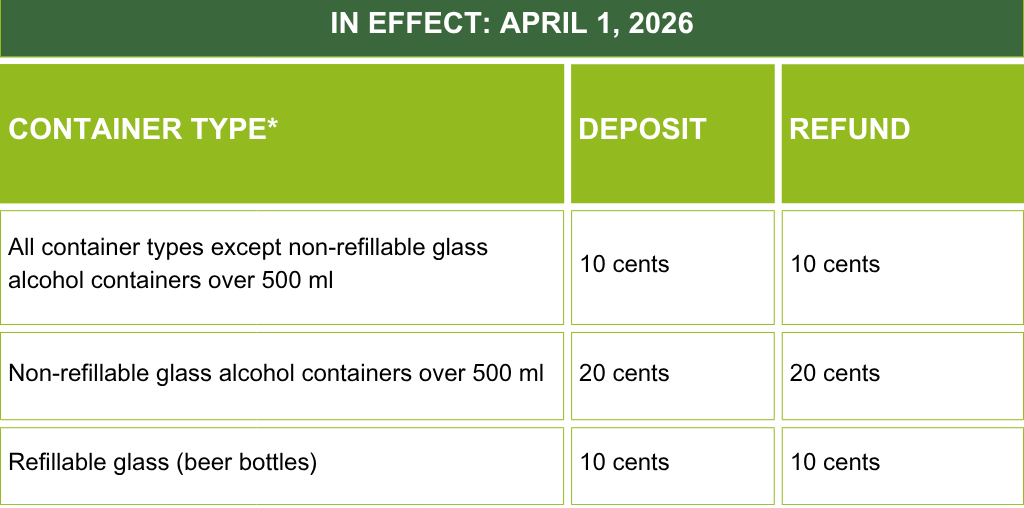
*Will apply to all beverage containers 5 L and under for products that fit the Regulations’ definition of “beverage.”
Container Recycling Fee
The Prince Edward Island Beverage Container Stewardship Program, managed by Encorp, will be funded by the sale of processed materials to commodity markets and from unredeemed beverage container deposits. Additionally, a CRF mechanism will be established on container material types.
This revenue will be utilized to support various Program activities, including administration and all applicable operating costs. The CRF will be calculated as the net cost of recycling beverage containers and will be based on these guiding principles:
- All material types must be self-sustaining.
- There can be no cross-subsidization of different material streams.
- Each stream is responsible for the direct costs of managing its containers as well as a portion of the indirect costs based primarily on market share.
While adjustments to CRFs are expected to occur annually, taking effect on April 1 of each year, Encorp reserves the right to adjust the CRFs at any time in response to unanticipated financial events. Any changes to the CRFs will be announced at least 90 days before they become effective.
The CRF rates for each container type, effective April 1, 2026, will be set by Encorp as follows.
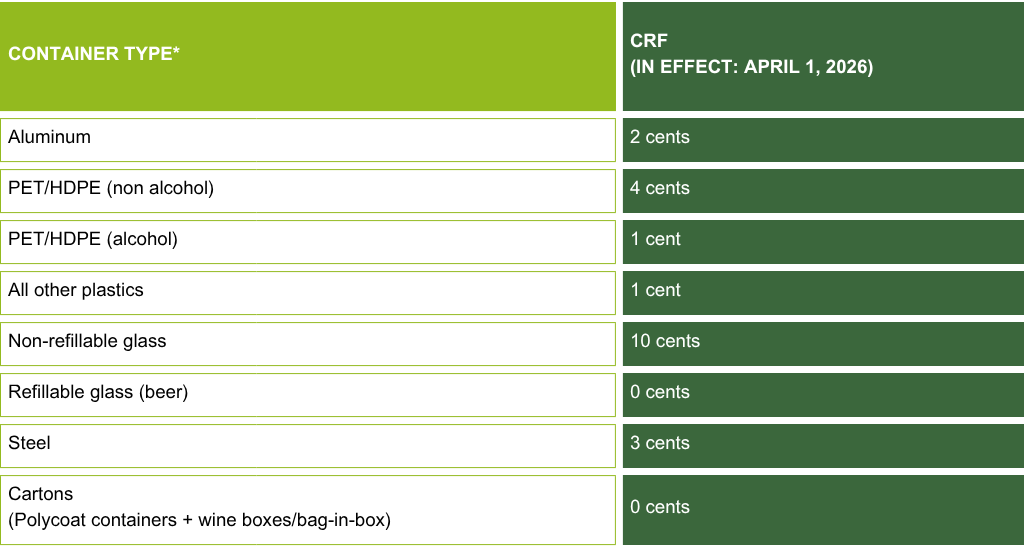
*Will apply to all beverage containers 5 L and under for products that fit the Regulations’ definition of “beverage.”
Recovering Costs
The Regulations do not prohibit producers from recovering the costs/fees related to their beverage containers recycling program, meaning the CRFs charged by Encorp.
Producers who wish to recover their CRF costs from consumers can either internalize the fees/include them in the total price of their beverage products or charge them directly to consumers as a separate fee on top of the beverage product price. The choice is left to industry and its retail partners.
FAQ
What is the difference between a CRF and a deposit?
A “CRF” stands for container recycling fee. It is an environmental handling/management fee charged to beverage producers to cover the estimated net costs of recovering and recycling the containers for their products. The exact amount set for each container depends on how cost-effective a container’s material type is to recycle. CRFs are a common and proven financing mechanism used successfully in many other Canadian provinces to fund the recycling of beverage containers. On April 1, 2026, Prince Edward Island will transition its Beverage Container Program to a full EPR model, with a CRF set by container type to cover the estimated net costs of recycling each material stream.
A “deposit” is a refundable fee that consumers pay when they purchase a ready-to-drink beverage product in a sealed container, in addition to the item’s price. It is intended to encourage consumers to return the empty beverage container for recycling or refilling instead of disposing of it in a landfill or as litter. Prince Edward Islanders are accustomed to paying a 10-cent deposit on some containers and a 20-cent deposit on others. Starting April 1, 2026, as required by the Materials Stewardship and Recycling Regulations, they will receive a full refund on deposits when they return empty beverage containers to designated return facilities.
Won’t the CRF be just another form of taxation?
No, Encorp is a not-for-profit PRO operated by the beverage industry. None of the CRFs or the deposits will go to any level of Government. The CRFs will be charged by Encorp directly to beverage producers to cover the estimated net costs of recycling their containers. CRFs are common in many other provinces and reflect the growing movement towards eco-packaging and producers taking full responsibility for the lifecycle of their products. There are costs involved in recycling beverage containers, and charging a CRF will be necessary to ensure the beverage container recycling system in Prince Edward Island remains financially sustainable.
Will tax be applied to the CRF?
Yes, the CRF will be subject to Prince Edward Island’s Harmonized Sales Tax (HST), regardless of whether the beverage itself is taxable or non-taxable. HST will be calculated at 15% on top of the CRF amounts.
Will I be able to pass on the costs of the CRFs?
The Materials Stewardship and Recycling Regulations do not prohibit producers from recovering the costs/fees related to their beverage containers recycling program, meaning the CRFs charged by Encorp.
Producers who wish to recover their CRF costs from consumers can either internalize the fees/include them in the total price of their beverage products or charge them directly to consumers as a separate fee on top of the beverage product price. The choice is left to industry and its retail partners.
Will tax be applied to the beverage container deposit?
No. Tax can only be applied to portions of the deposit that are not refunded to consumers. Because the new EPR Program will implement a fully refundable deposit system on April 1, 2026, deposits will no longer be taxable.
Why not raise the deposit amount on beverage containers in Prince Edward Island,
Encorp will aim to improve the return and redemption experience for used beverage containers in partnership with local return facility operators over the next few years, enhancing access and convenience for recycling across the province before considering any potential increase in container deposits.
Are there any types of beverage containers that will not be included in the Prince Edward Island Beverage Container Stewardship Program?
Only sealed containers for ready-to-drink beverage products that fit the definition of “beverage” found in the Materials Stewardship and Recycling Regulations will be included in the Beverage Container Stewardship Program and considered deposit-bearing. Producers should also ensure that deposit-bearing beverages are packaged in containers using material types from Encorp’s list of accepted materials.
Additionally, containers greater than 5 L or containers that consumers can bring back to a retailer to be refilled (such as flagons/growlers) will not be part of the Beverage Container Stewardship Program and will not be subject to deposits or CRFs.